Trickbot is not a new threat, but it is an evolving one. The latest twist of the banking Trojan knife as far as Windows 10 users are concerned is the addition of new methods to not only evade but actually disable Windows Defender security protection. As reported on July 14 in Forbes , Trickbot is a particularly stealthy banking Trojan that has been around since 2016. Since then, it was thought to have compromised no less than 250 million email accounts in an effort to distribute the malware payload. That payload includes the stealing of online banking credentials and cryptocurrency wallets. Microsoft has always been front and center as far as Trickbot attack campaigns are concerned, with weaponized Word and Excel files being a favored approach. The latest campaign is targeting Windows 10 users and implementing a highly detailed and convincing, but fake nonetheless, Office 365 page to prompt for browser updates that install the Trojan itself. Disab...
Wildcards (also referred to as meta characters) are symbols or special characters that represent other characters. You can use them with any command such as ls command or rm command to list or remove files matching a given criteria, receptively.
These wildcards are interpreted by the shell and the results are returned to the command you run. There are three main wildcards in Linux:
- An asterisk
(*)– matches one or more occurrences of any character, including no character. - Question mark
(?)– represents or matches a single occurrence of any character. - Bracketed characters
([ ])– matches any occurrence of character enclosed in the square brackets. It is possible to use different types of characters (alphanumeric characters): numbers, letters, other special characters etc.
You need to carefully choose which wildcard to use to match correct filenames: it is also possible to combine all of them in one operation as explained in the examples below.
How to Match Filenames Using Wildcards in Linux
For the purpose of this article, we will use following files to demonstrate each example.
1. This command matches all files with names starting with
l (which is the prefix) and ending with one or more occurrences of any character.
List Files with Character
2. This example shows another use of
* to copy all filenames prefixed with users-0 and ending with one or more occurrences of any character.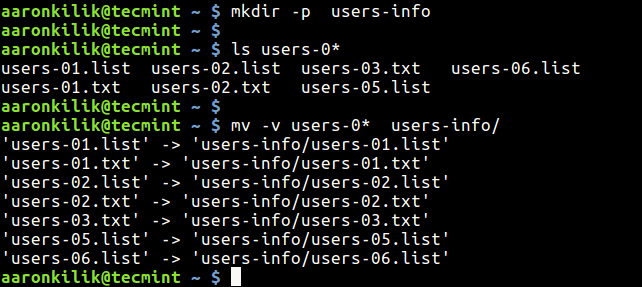
List and Copy All Files
3. The following command matches all files with names beginning with
l followed by any single character and ending with st.sh (which is the suffix).
Match File with Character Name
4. The command below matches all files with names starting with
l followed by any of the characters in the square bracket but ending with st.sh.
Matching Files with Names
How to Combine Wildcards to Match Filenames in Linux
You can combine wildcards to build a complex filename matching criteria as described in the following examples.
5. This command will match all filenames prefixed with any two characters followed by
st but ending with one or more occurrence of any character.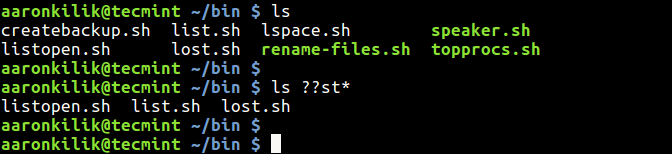
Match File Names with Prefix
6. This example matches filenames starting with any of these characters
[clst] and ending with one or more occurrence of any character.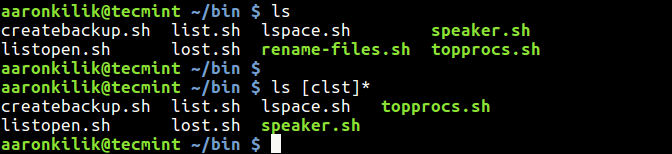
Match Files with Characters
7. In this examples, only filenames starting with any of these characters
[clst] followed by one of these [io] and then any single character, followed by a tand lastly, one or more occurrence of any character will be listed.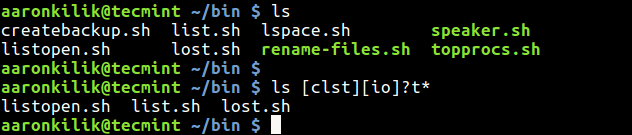
List Files with Multiple Characters
8. Here, filenames prefixed with one or more occurrence of any character, followed by the letters
tar and ending with one or more occurrence of any character will be removed.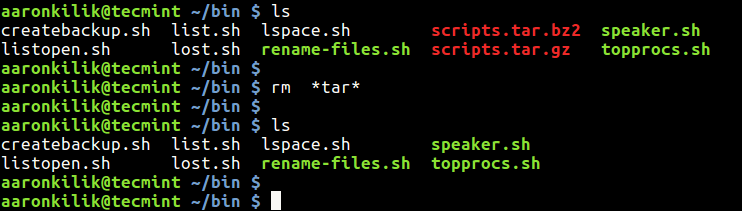
Remove Files with Character Letters
How to Match Characters Set in Linux
9. Now lets look at how to specify a set of characters. Consider the filenames below containing system users information.
This command will match all files whose name starts with
users-i, followed by a number, a lower case letter or number, then a number and ends with one or more occurrences of any character.
The next command matches filenames beginning with
users-i, followed by a number, a lower or upper case letter or number, then a number and ends with one or more occurrences of any character.
This command that follows will match all filenames beginning with
users-i, followed by a number, a lower or upper case letter or number, then a lower or upper case letter and ends with one or more occurrences of any character.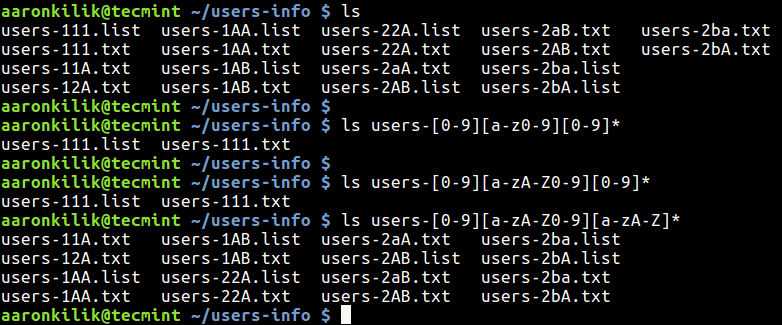
Match Characters in Filenames
How to Negate a Set of Characters in Linux
10. You can as well negate a set of characters using the
! symbol. The following command lists all filenames starting with users-i, followed by a number, any valid file naming character apart from a number, then a lower or upper case letter and ends with one or more occurrences of any character.
That’s all for now! If you have tried out the above examples, you should now have a good understanding of how wildcards work to match filenames in Linux.
Source:here
Comments
Post a Comment