Trickbot is not a new threat, but it is an evolving one. The latest twist of the banking Trojan knife as far as Windows 10 users are concerned is the addition of new methods to not only evade but actually disable Windows Defender security protection. As reported on July 14 in Forbes , Trickbot is a particularly stealthy banking Trojan that has been around since 2016. Since then, it was thought to have compromised no less than 250 million email accounts in an effort to distribute the malware payload. That payload includes the stealing of online banking credentials and cryptocurrency wallets. Microsoft has always been front and center as far as Trickbot attack campaigns are concerned, with weaponized Word and Excel files being a favored approach. The latest campaign is targeting Windows 10 users and implementing a highly detailed and convincing, but fake nonetheless, Office 365 page to prompt for browser updates that install the Trojan itself. Disab...
 My setup. Happy Hacking Linux installed in a Macbook Air 2013.
As a software engineer, learning Linux was the best time investment I've made. Since it user needs to understand and maintain, daily experience feels like adding a drop to the puddle. After long time, the puddle becomes a lake, or even an ocean.
Today as a 30 years old engineer, I still benefit from little chunks of knowledge that I happened to learn years ago, when I was an ambitious beginner. In another blog post, I explain more about why Linux is more pragmatic option for software developers.
In this blog post I'll share less popular but very useful Linux commands I personally use and recommend. If you're on a Macbook, that's fine, because most of the commands I'll mention also exist in OSX.
10. file
Returns information for given file. For example, you can print the size information of an image:
file logo.png
Returns:
> PNG image data, 16 x 16, 8-bit/color RGBA, non-interlaced
9. iotop, powertop, nethogs
How would you monitor what's happening in a Linux system ? These three commands are life savers;
iotop: Sorts processes by disk writes, and show how much and how frequently programs are writing to the disk.powertop: Lists processes by their energy consume. It's a vital command when you're outside, somewhere you can't charge your laptop.nethogs: Lists processes by their network traffic.
8. tee
It splits the output of a program, so we can both print & save it. For example, add a new entry to hosts file;
echo "127.0.0.1 foobar" | sudo tee -a /etc/hosts7. pidof, kill and pkill
These three important commands help you control running programs in your system.
pidof prints out the process id of a running program. For example, below command will output the process ID of nginx:pidof nginx
You can kill nginx by taking that number and giving to
killcommand:kill -USR2 'pidof nginx'pkill is a shortcut command that kills the process matching pattern:pkill -f nginx6. tmux
You gotta install tmux if you haven't yet. Tmux is an excellent window and session manager for your terminal.
5. tree
Lists contents of a directory in tree-like format. It has neat options like showing only directories;
tree -d4. find
This command is a life-saver when we are looking for specific files around dozens of others. I'll cover a few simple use cases of it here.
Example 1: List all CSS files (including subdirectories):
find . -type f -name *.css
Example 2: List all CSS or HTML files:
find . -type f \( -name "*.css" -or -name "*.html" \)3. htop
Famous process monitor. It has a nice, colorful command-line UI. Some useful keybindings:
\Filter/Search,Choose sorting criteriakSend kill signaluFilter results by usertOpen/close tree mode-and+Collabse / uncollapse selected process treeHTurn off displaying threads
2. chroot
Magicians love this command because it opens up a new TTY in given directory. Which means, you can create a folder, set up a new Linux system inside, and switch to that "child system" whenever you want.
Isn't it powerful ?
1. dialog
A very simple and nice way to interact with the user on command-line. For example, this command below shows a nice input box:
dialog --title "Oh hey" --inputbox "Howdy?" 8 55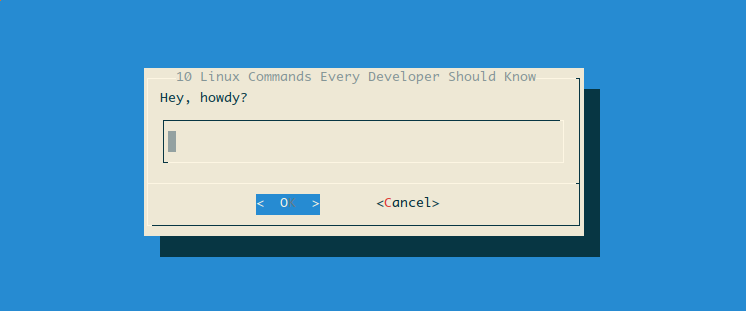
It exists on both Linux and OSX systems, and supports many other kind of dialogs; message boxes, menus, confirms, progress bars... The installation wizard I coded for Happy Hacking Linux is made with this amazing command!
Source:here
Comments
Post a Comment